Unlock ultimate freedom. Discover how much does it cost to fly private jet in 2026. Get instant quotes, compare fleet rates, and book your flight today.
The New Standard of Global Mobility: Why Your Time is the Ultimate Asset
In the high-stakes world of international commerce and elite lifestyle management, the most precious commodity isn’t gold or data—it’s time. For the modern titan of industry, the business executive, and the discerning luxury traveler, the limitations of commercial aviation are no longer just an inconvenience; they are a strategic liability. When you ask, “how much does it cost to fly private jet,” you aren’t just looking for a number on a ledger. You are evaluating the price of absolute control, total privacy, and the ability to reclaim hours that would otherwise be lost to the terminal’s friction.
The transition from the first-class cabin to a private fuselage is a paradigm shift. It is the evolution from being a passenger on someone else’s schedule to becoming the architect of your own itinerary. In 2026, the private aviation market has matured into a seamless, technology-driven ecosystem where transparency meets tradition. This guide provides a concierge-level breakdown of the financial structures behind private flight, ensuring you make an informed decision that prioritizes both your capital and your comfort. Whether you are conducting a cross-continental board meeting or whisking your family away to a remote estate, the value of private flight is measured in the moments saved and the discretion maintained.
Secure Your Absolute Freedom
Stop waiting for the world to move. Access over 10,000 aircraft globally with a single click. Instant, transparent, and discreet.
Book Your Private Jet NowThe Psychology of Private Aviation: Productivity at 45,000 Feet
For the business executive, the private cabin isn’t just a seat; it’s a mobile headquarters. In a commercial first-class cabin, despite the partitions, you are never truly alone. Sensitive mergers, acquisitions, and strategic pivots cannot be discussed when a competitor might be sitting across the aisle. Private aviation provides an airtight seal of confidentiality. This discreet luxury allows teams to work through the flight, arriving at their destination prepared and aligned, often completing an entire day’s work before the wheels even touch the tarmac.
Furthermore, the physiological impact of private travel cannot be overstated. Modern private jets are equipped with advanced humidification systems and lower cabin altitudes, which significantly reduce jet lag. When you arrive at your destination feeling refreshed rather than depleted, your performance at the subsequent meeting is measurably higher. This is the “hidden ROI” of private flight—the value of your peak cognitive performance.
Flight Time and Distance Overview: The Efficiency Analysis
When calculating the cost-benefit ratio of private flight, the primary metric is efficiency. A private jet eliminates the “dead time” associated with commercial hubs, allowing for a streamlined door-to-door experience.
Total Operational Control: The Power of Airport Flexibility
One of the most profound advantages of private aviation is airport flexibility. While commercial airlines are limited to a handful of major hubs (which are often hours away from your actual destination), a private jet can access over 5,000 regional and executive airports in the US alone—and thousands more globally. This allows you to fly into a private terminal (FBO) located just ten minutes from your office or estate.
In a private terminal, the experience is defined by discreet luxury. There are no queues, no invasive security checkpoints, and no public exposure. Your manifest is private, and your movement is seamless. This logistical precision doesn’t just reduce stress; it increases the ROI of your journey by ensuring that every minute of your trip is spent either in productive work or restorative rest. Consider the advantage of landing at Teterboro (TEB) instead of JFK, or Northolt (NHT) instead of Heathrow—you are in the heart of the city while the commercial passengers are still waiting at the luggage carousel.
The Mechanics of Charter Pricing: What You’re Really Paying For
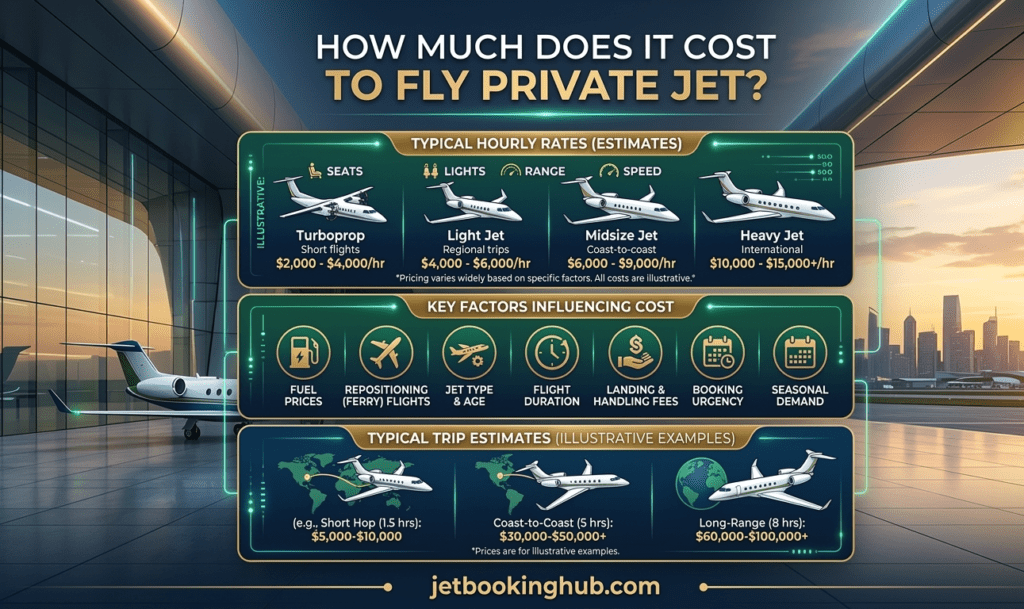
To understand how much does it cost to fly private jet, one must look under the hood of the pricing model. Unlike a standard airline ticket, you are leasing the entire aircraft. This includes:
- Hourly Rates: The base cost to operate the machinery.
- Fuel Surcharges: Dynamic costs that fluctuate with the global market.
- Landing and Handling Fees: Payments to the FBOs for tarmac space and hangarage.
- Crew Overnight Fees: If the aircraft stays with you, you cover the professional crew’s logistics.
- Positioning Costs: Bringing the jet from its home base to your departure point.
Selecting Your Fleet: Recommended Aircraft for Every Mission
The question of how much does it cost to fly private jet is fundamentally tied to the airframe you select. Each aircraft class is designed for a specific mission profile, from regional hops to transcontinental jumps.
Understanding the Competitive Edge of Group Travel
One common misconception is that private flight is always vastly more expensive than commercial travel. However, when you perform a private jet vs first class price comparison for a group, the math shifts significantly. If you are booking eight first-class seats for a leadership team on a transcontinental route, the cumulative cost can easily exceed $80,000. For that same price, you could charter a midsize jet, gain 100% privacy, and save each of those eight executives five hours of transit time. That is 40 man-hours of high-level productivity reclaimed. In the corporate world, that is a massive net gain.
Financial Transparency: Estimated Price Range with Details
Understanding the cost structure of private aviation requires looking at the hourly rates and the mission specifics. Prices are determined by aircraft availability, fuel prices, landing fees, and positioning costs.
Strategic Opportunity: The Empty Leg Advantage
For the sophisticated traveler with a flexible itinerary, the empty leg opportunity represents the single most cost-effective way to experience private aviation. An “empty leg” occurs when a jet has been chartered for a one-way trip and must fly back to its home base or reposition for its next mission without passengers.



To avoid flying empty, operators offer these repositioning legs at a massive discount—often 50% to 75% off the standard charter rate. By leveraging our real-time network, you can secure an entire heavy jet for the price of a midsize, or a light jet for the price of a commercial first-class ticket. This allows you to enjoy the full suite of executive jet charter benefits while significantly optimizing your travel budget. It is the ultimate market arbitrage for those who value both quality and value.
Personalization and Concierge Services
The cost of your flight also covers a level of personalization that is impossible in commercial aviation. From catering sourced from Michelin-starred restaurants to specific cabin configurations for sleeping or conferencing, every detail is tailored to your preference. Whether you require a specific vintage of wine or a specialized medical set-up for an elderly relative, the concierge service ensures your environment is exactly as you desire.
Frequently Asked Questions (FAQ)
1. How much does it cost to fly private jet on average for a domestic flight?
For a 2-hour domestic flight in a light jet, expect a price range between $12,000 and $20,000. This includes all landing fees and standard catering. Prices vary based on real-time availability and aircraft positioning.
2. Are there hidden fees in private jet charter pricing?
At Villiers, we prioritize transparency. Typical costs include the hourly rate, fuel surcharges, and landing fees. De-icing (in winter) and ultra-premium catering requests are additional, but these are always discussed upfront during the quote process.
3. Is private jet vs first class price comparable?
When traveling as a group of 6 or more, the per-person cost of a private charter begins to align with high-end commercial first-class tickets. However, the value of discreet luxury and time saved often makes private aviation the superior choice for professionals.
4. How soon can a private jet be ready for departure?
Through our concierge-level service, we can often have an aircraft wheels-up within 2 to 4 hours of your initial request. Our platform connects you to the live global fleet for maximum urgency and flexibility.
5. What is the baggage capacity on a private jet?
Baggage capacity depends on the aircraft class. While a Light Jet is ideal for carry-ons and soft luggage, a Heavy Jet can accommodate multiple full-sized suitcases, sporting equipment, and even pets in the cabin, ensuring a seamless luxury experience.
The Pinnacle of Travel Awaits
Stop asking how much it costs to fly private and start experiencing why the world’s leaders choose us. Your aircraft is waiting on the tarmac.
Explore the Live Fleet NowDiscretion Guaranteed | Instant Quotes | 24/7 Global Support
Essential Benefits of Chartering a Private Jet
What to Expect When Flying Private
How billionaires travel without airports
No responses yet